








China Suppliers Factory Small-Scale Prismatic Cell Lab Line Solution for Battery R&D and Low-Volume Production
Battery innovation demands precision. Our lab-scale prismatic cell production line enables customers to rapidly validate new battery chemistries and optimize manufacturing processes before scaling to mass production.
Key Advantages
Performance & Design
- ✓ High-precision equipment for consistent cell performance
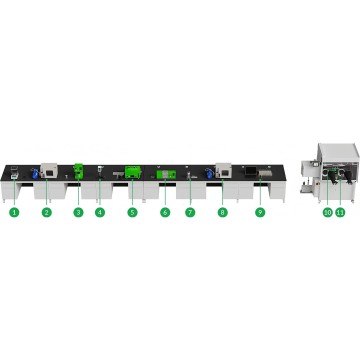
- ✓ Modular design for flexible lab layouts
- ✓ Suitable for R&D, pilot-scale production, and university laboratories
- ✓ Supports customized cell dimensions and specifications
Chemistry Compatibility
- ✓ Compatible with multiple chemistries including:
- Lithium Iron Phosphate (LFP)
- Nickel Manganese Cobalt (NMC)
- Lithium Cobalt Oxide (LCO)
- Solid-state battery research materials
Frequently Asked Questions
What is a lab-scale prismatic cell production line used for?
It is primarily designed for R&D centers, universities, and pilot manufacturing plants to test and validate new battery formulations, optimize production parameters, and produce prototype prismatic cells prior to high-volume commercial manufacturing.
Can this production line accommodate custom cell sizes?
Yes, the line features a flexible and modular design that supports customized cell dimensions, casing thicknesses, and specific engineering parameters according to your testing requirements.
Which battery chemistries can be processed on this line?
The system supports various standard and advanced battery chemistries, including Lithium Iron Phosphate (LFP), Nickel Manganese Cobalt (NMC), Lithium Cobalt Oxide (LCO), and next-generation solid-state battery research materials.
How does modular design benefit laboratory operations?
Modular design allows equipment to be easily integrated into limited lab spaces, reconfigured for different research processes, and expanded incrementally as testing requirements grow.
How does precision equipment affect battery R&D outcomes?
High-precision processing ensures consistent electrode coating, winding/stacking, and sealing, reducing variability between batches so researchers can accurately evaluate material performance.